

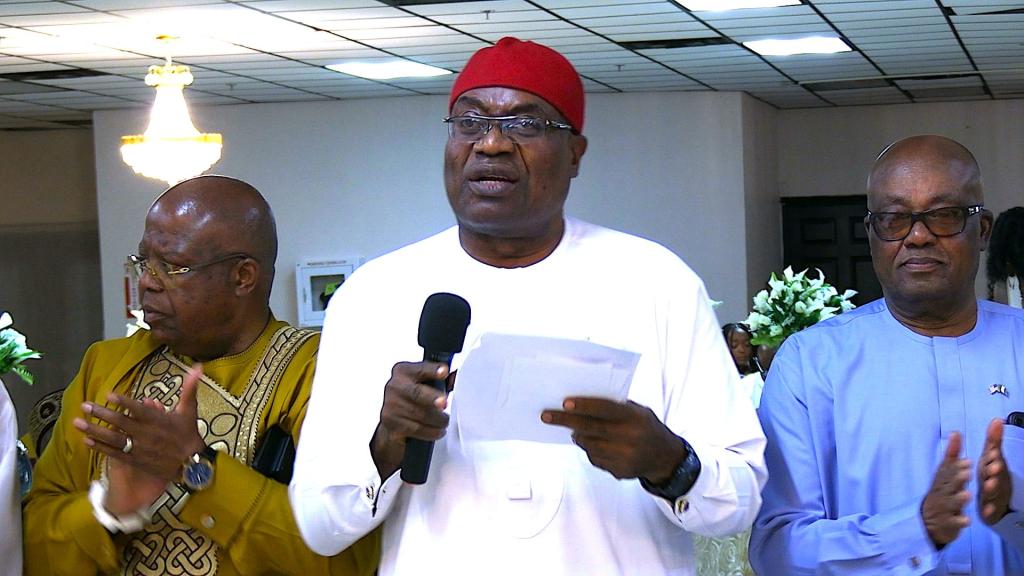
With the rising insecurity in Nigeria, the US based Nigerian, Dr. John Egbo, has again, tasked Nigerian government to demonstrate genuine commitment in its fight against insecurity to end killings of Nigerians across the country by terrorists.
Egbo, who is a Deputy Sheriff rtd from the United States of America and Security Consultant, stated this in statement on Monday in Enugu.
According him, the public is demanding a shift from rhetoric to action as experts recommend reduction in VIP security escorts and redeploying personnel to communities.
He advocated that governments should order their National Assembly members and Ministers back to their respective towns to empower both Neighborhood Watch (Vigilantes) and Forest Guards as a first line protection for their people during the upcoming yuletide.
He equally advocated for mproved welfare and insurance for police and military officers as well as deploying drones, surveillance systems, and intelligence tools for security personnel.
"Federal Government should creating state policing structures as promised by the President to adopting a multi-layered policing model and ensuring transparency in defence spending and procurement.
"They should sign an agreement with a foreign country to help flush out terrorists from the country and secure our porous borders, improve coordination among the armed forces, police, DSS, and local vigilantes.
"Ultimately, Nigerians want a leadership that demonstrates genuine commitment, not just speeches," Egbo stressed.
He noted that a leadership that recognizes that security was not a privilege for the powerful, but a right for every citizen.
Egbo pointed out that insecurity grows more brazen and kidnappers become more entrenched, the nation faces a stark choice, noting that continuing on the current path of reactive measures, or embrace bold reforms that restore public trust and reclaim Nigeria from the grip of terrorists.
"The people have spoken loudly and the country’s leaders can no longer afford to ignore them.
"For millions of Nigerians, the fear of being kidnapped on the road, at home, or even in school has become a grim part of daily existence.
"From the outskirts of Abuja to rural communities in Kaduna, Kwara, Niger, Katsina, Plateau, Benue, Rivers, and Zamfara, the wave of abductions continues to rise, eroding public confidence and raising urgent questions about the priorities of the country’s political leadership," he noted
The US based Nigerian observed that despite repeated promises from successive administrations, Nigerians widely believe that national security was still treated with alarming levity by those at the highest levels of government.
"From the Presidency to the National Assembly and the state governors, there is a growing public perception that the nation’s leaders are more focused on protecting themselves and their families, with troops of police officers, army personnel and DSS than ensuring the safety of the people they are supposed to serve," he observed.
He said that kidnapping for ransom had evolved into a multi-billion-naira criminal industry as major highways such as Abuja–Kaduna, Enugu–Abuja, Benin–Lagos, and Birnin Gwari–Funtua had witnessed repeated attacks.
According to him, communities in the Middle Belt and North-West live under a constant shadow of terrorists called bandits, militants and herdsmen while southern states once considered safe such as Edo, Delta, Imo, and Anambra, now report near-daily abductions.
Egbo explained that in early 2025 alone, several communities recorded mass kidnappings, including farmers, schoolchildren, church members, and even traditional rulers.
"For many Nigerians, these incidents underscore what they see as a failure of political will of Nigeria’s style of leadership. They travel overseas for medical treatment but will not hire foreign trained officers to help with their sick security condition.
"A trader in Suleja, who narrowly survived an attack, told our reporter: “We are left to protect ourselves.
"The leaders are surrounded by dozens of security men, but ordinary people are on their own. It seems we are not part of the security equation.” he stated.
He quoted Analysts arguing that a major source of public resentment waa the disproportionate deployment of security personnel to political leadership.
"Thousands of police officers are attached to politicians, government officials, business moguls, and their families, while rural communities and urban neighborhoods struggle with inadequate policing.
A retired police superintendent, who requested anonymity, described the situation bluntly:
“We lack manpower not because officers don’t exist, but because many of them are guarding VIPs. If you withdraw and equip half of those officers and send them back to communities, you will see an immediate improvement in national security.” he said.
He decried that despite generous annual allocations running into trillions of naira for defense and monthly Security Votes to Governors, internal security, frontline officers often lack basic equipment such as bulletproof vests, patrol vehicles, communication gadgets, and sometimes even fuel.
Many of the security personnel, he observed, work long hours under hazardous conditions with limited insurance or welfare support.
"This mismatch between resources and results has fuelled widespread frustration among service men in uniform.Critics say part of the problem lies in the politicization of security agencies.
"Postings, promotions, and procurement decisions have sometimes been influenced by political considerations rather than merit, weakening professionalism within the security sector.
"Moreover, security responses have often been reactive rather than proactive," Egbo stressed.
He explained thatGovernment interventions typically occur after tragic incidents as in mass abductions in Kebbi school where there was an intelligence before the attack took place and Niger students incidents, attacks on villages, or high-profile kidnappings—rather than through coordinated preventive strategies.
He quoted asecurity researcher at the University of Ibadan, Dr. Tolu Adebayo, summarising the problem:
“We cannot continue waiting for attacks before deploying resources. Kidnapping gangs have saboteurs in the military and they are adapting faster than our institutions. Without intelligence-led policing, improved welfare, and professional autonomy, the cycle will continue unabated”.
"For ordinary Nigerians, he added that the consequences of insecurity are devastating. Farmers are abandoning their farmlands for fear of attack.
"Transporters avoid certain highways. Unity schools have been ordered closed in many states of the North while other Schools in high-risk regions operate under threat. Businesses are closing, and families are selling property to pay ransoms.
"An Enugu resident whose cousin was abducted in 2024 expressed anger at government inaction:“Every day we hear politicians talking about billions spent on security," Egbo concluded.